

Starting a matcha brand is an exciting journey, but it requires navigating a complex supply chain, from sourcing authentic tea leaves to choosing the right packaging and marketing. As an independent guide, we are here to provide you with neutral, comprehensive information so you can make the best decisions for your specific brand and budget.
Before diving into the supply chain, your first task is to figure out what type of matcha business you want to run and what makes it unique. You need to build a brand story and identity that truly resonates with your target customers. Once your brand positioning is clear—whether you are focusing on traditional tea ceremonies, modern café beverages, or baking—you can effectively choose the right product grades, packaging, and finally, execute your marketing strategy.
Step 1: Source the Right Matcha for Your Brand Identity
Choosing the right source is the foundation of your business. You should partner with manufacturers that have a profound background in tea cultivation, a highly transparent supply chain, and verifiable quality standards.
Authenticity is critical. We recommend sourcing directly from famous core producing areas, such as Uji or Nishio, where the unique microclimate and soil conditions produce premium tea leaves. Before making a commitment, ask potential suppliers about their processing techniques, harvesting methods, and grading systems. A reliable manufacturer will offer full transparency regarding the matcha’s origin, freshness level, and exact flavor profile.
To help you decide what to source, here is a quick breakdown of the three main matcha grades:
Ceremonial Grade: This is the highest quality, made from the youngest tea leaves. It’s incredibly smooth, with a deep umami flavor and a naturally sweet finish. Best enjoyed on its own, whisked with hot water (usucha) or prepared as a thicker tea (koicha).
Premium/Latte Grade: Still very high quality, but designed to hold up beautifully when mixed with milk or sweeteners. It has a bolder flavor that won’t get lost and a vibrant color that stays true. Perfect for lattes, smoothies, and mixed beverages.
Culinary Grade: A more robust grade best suited for baking and cooking. Its flavor is stronger and can withstand heat better. While great for adding matcha flavor to food, it’s generally not recommended for drinking straight.
Understanding these grades will help you align your sourcing strategy with your brand’s target market and product line.
Step 2: Choose the Right Packaging
Matcha is extremely delicate. Its worst enemies are light, air, moisture, and heat. Improper storage leads to a dull color, flat taste, and lost nutrients. Therefore, packaging is the most critical physical investment you will make. Here is an objective comparison of the most common packaging options:
Foil Bags & Pouches: Highly cost-effective, but once opened, powder clumps easily and lacks a premium unboxing feel.
Glass Jars: Beautiful and recyclable, but not lightproof! UV rays easily degrade the green color. Heavy for shipping.
Paper Tubes: Eco-friendly and lightweight, but poor moisture barrier compared to metal.
Metal Tins: 100% lightproof, completely airtight, and structurally rigid. Perfect for premium retail and long-term storage, but requires a higher unit cost and printing MOQ.
Based on the comparison above, if your budget allows and you are targeting the premium market, metal tins are a highly reliable investment.
2.1 When sourcing metal tins, how do you choose a reliable supplier?
A top-tier manufacturer should meet the following industry standards:
• 100% Food-Grade & Superior Protection
• Advanced Sealing Options
• Premium Craftsmanship & Finishes
• Flexible Sizes for Every Need & Diverse Design Capabilities
2.2 Meet Our Premium Matcha Tins
If you are looking for a manufacturer that checks all the boxes above, we are here to help. Our custom matcha tins are specifically engineered to meet these high standards:
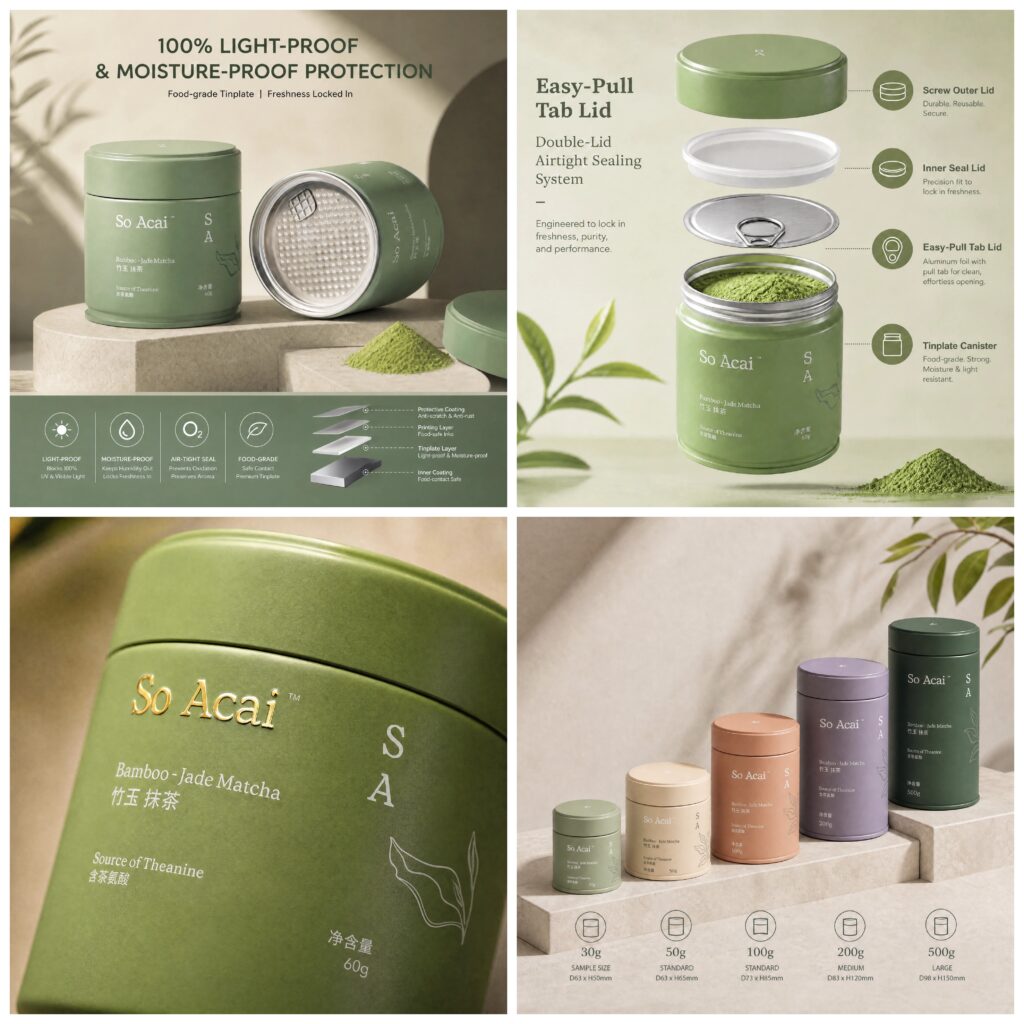
2.2.1 Superior Protection: Made of 100% food-grade tinplate, fully opaque and blocking 100% of UV light to prevent oxidation.
2.2.2 Advanced Sealing Options: Offer Double-Lid designs for daily reuse, Easy-Peel Aluminum Foil membranes for factory tamper-evident sealing, and Screw-top or Multi-Friction lids for consistent airtight performance.
2.2.3 Premium Craftsmanship & Finishes: Support Matte/Glossy finishes, and orange peel textures, along with CMYK printing, Pantone matching, and gold/silver hot stamping.
2.2.4 Flexible Sizes & Diverse Designs: Provide a wide range of standard sizes and support custom dimensions to fit your exact product weight. Whether you want minimalist solid colors, Japanese aesthetics, or vibrant pop-art gradients, our expertise brings any artwork to life.
2.3 A Quick Note on Sealing
If you choose metal tins, the top opening typically comes pre-sealed with an easy-peel foil membrane or a ring-pull lid straight from the factory. Because the top is already sealed, you will fill the matcha powder from the bottom. After filling, you need to use a basic bottom sealing machine to securely press and seal the metal bottom lid onto the can body. This completes the 100% airtight and tamper-evident packaging process before applying the outer decorative lid.
Step 3: Overcome the “Low MOQ” Dilemma for Startups
As a startup, you likely want to test the market with a small batch before scaling up. However, when sourcing premium metal tins, you will quickly encounter a common industry barrier: custom-printed tins usually require a high Minimum Order Quantity (MOQ) of 1000pcs or more.
3.1 Why is the MOQ so high?
3.1.1 Setup Costs & Printing Plates:
Custom printing (like CMYK or Pantone) requires creating physical printing plates for each color. Setting up the offset printing machine, aligning the colors, and running test sheets takes significant time and generates waste. Factories need a certain order volume to absorb these setup costs so they can offer you a reasonable unit price.
3.1.2 Raw Material Procurement:
Tinplate is purchased in large flat sheets (or coils) from steel mills. Cutting and stamping these sheets into round canisters inevitably creates edge waste. If the order is too small, the material waste ratio becomes too high, making it economically unviable for the factory to produce.
3.1.3 Production Line Efficiency:
A modern metal packaging line runs at high speeds. The time and labor required to set up, run, and clean a machine for a 500-piece order are almost the same as for a 5,000-piece order. High MOQs ensure production efficiency and keep overall manufacturing costs down.
3.2 How to break this barrier?
Here are three practical solutions:
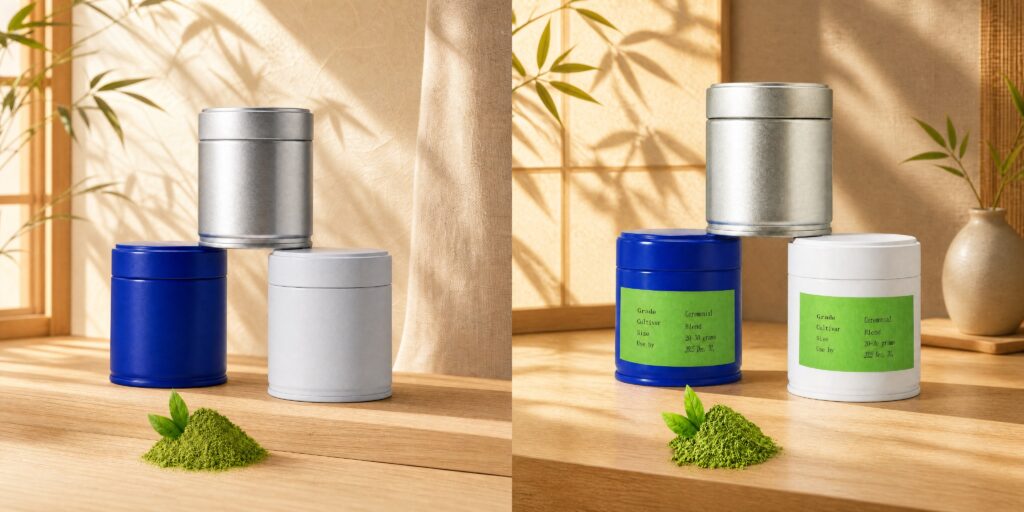
Solution 1: Blank Tins + Custom Sticker Labels (Highly Recommended)
Instead of printing directly on the metal, you can source high-quality non-printed blank tins (in silver, blue, or white) which have a much lower MOQ. Then, design custom sticker labels to wrap around them. This gives you a premium look without the high upfront printing cost. This solution is especially ideal if you are planning to launch a line with multiple matcha flavors.
Solution 2: Use Standard Stock Molds & Sizes
Avoid customizing the shape or height of the tin in your first order. By using standard factory molds and standard sizes (like 30g or 50g), you bypass the expensive mold-opening fees. Combined with a simple one or two-color logo print, you can keep the MOQ and unit price lower than full-color custom shapes.
Solution 3: Scale Up Your First Order
If you have a solid marketing plan and a clear customer base, you might bite the bullet and order the 1,000pcs. While the upfront cost is higher, the unit price for each tin will be much cheaper. You can use them as inventory for the first 1-2 years.
Step 4: Master the Art of Storage & Sealing
Having the right packaging is the foundation of matcha preservation. However, how you store and seal the matcha before shipping is what truly maximizes the performance of your packaging. Regardless of which packaging material you choose, matcha degrades rapidly when exposed to heat, light, and oxygen.
4.1 Pre-Shipment Storage
• Temperature Control: Store your bulk matcha and empty tins in a cool, dry, and dark warehouse. Avoid areas near windows or heating systems. Many premium brands even use cold storage for their unopened bulk matcha to preserve the vibrant green color and fresh umami flavor for months.
• Humidity Management: Matcha is highly hygroscopic. Ensure your filling environment is strictly humidity-controlled to prevent clumping.
4.2 The Sealing Process
• Top Sealing: Ready-Made Inner Seals: When you source metal tins from professional manufacturers, the top opening is typically delivered already equipped with an easy-peel foil membrane or an easy-pull tab lid. This factory-applied tamper-evident barrier is crucial for blocking oxygen and moisture.
• Bottom Sealing: The Final Step After Filling: Because the top is pre-sealed, how do you fill the matcha? Through the bottom. After filling, you will need a basic bottom sealing machine to securely press and seal the metal bottom lid onto the can body. This completes the airtight packaging process before applying the outer decorative lid.
4.3 Consumer Usage
Include a small card in your packaging advising customers to keep the tin in a dark cabinet and consume it within a certain period after opening.
Step 5: Marketing, Sales & Building Your Community
Once your product is beautifully packaged and securely sealed, it’s time to sell. As a new matcha brand, you need to do more than just list products; you need to build a community.
5.1 Define Your Brand Identity by Matcha Grade
• For Ceremonial Grade: Position your brand as premium and traditional. Target tea enthusiasts and luxury gift buyers. Your marketing should emphasize the origin (e.g., Uji) and the authentic whisking ritual.
• For Premium/Latte Grade: Position your brand as modern, trendy, and wellness-focused. Target cafés, smoothie shops, and younger consumers who love matcha lattes. Your marketing should focus on vibrant aesthetics and healthy lifestyles.
• For Culinary Grade: Position your brand as accessible, versatile, and cost-effective. Target home bakers and food manufacturers. Marketing should focus on baking recipes and everyday usage.
5.2 Engage Customers Through Educational Content
Sharing knowledge about matcha is key to building a loyal following. When people understand the care that goes into producing high-quality matcha (like the grades and origins), they appreciate it more. You can create blog posts, short videos, or host online Q&A sessions. Explaining the difference between ceremonial and culinary grades, for example, helps customers make informed choices and feel more connected to your brand.
5.3 Leverage Social Media & Presentation Art
• Visuals & Behind-the-Scenes: Social media (Instagram, TikTok, Xiaohongshu) is highly visual. Show off your packaging and high-quality powder, and share behind-the-scenes glimpses of your sourcing or preparation. Use relevant hashtags to help new people discover your brand.
• The Art of Beverage Crafting: Teach your customers how to use your matcha. Share tips on whisking techniques using a bamboo whisk (chasen) to create a frothy base. For lattes, suggest oat milk or whole milk for the best foam, and remind them to balance the matcha-to-milk ratio for the perfect vibrant color and flavor.
5.4 Foster Loyalty Through E-commerce & Exceptional Service
• The Power of Unboxing: Build your own website (Shopify is great for beginners). Use aesthetic unboxing videos to showcase whatever packaging you chose (the pop of a foil bag, the smooth texture of a glass jar, or the premium feel of a tin), and the vibrant green powder inside.
• Exceptional Service: Good customer service goes a long way. Be responsive to inquiries and make the purchasing process smooth. Consider personalized touches, like a handwritten thank-you note with an order. Building relationships, rather than just making sales, is what creates a lasting community around your matcha business.
5.5 Sell Beyond E-commerce
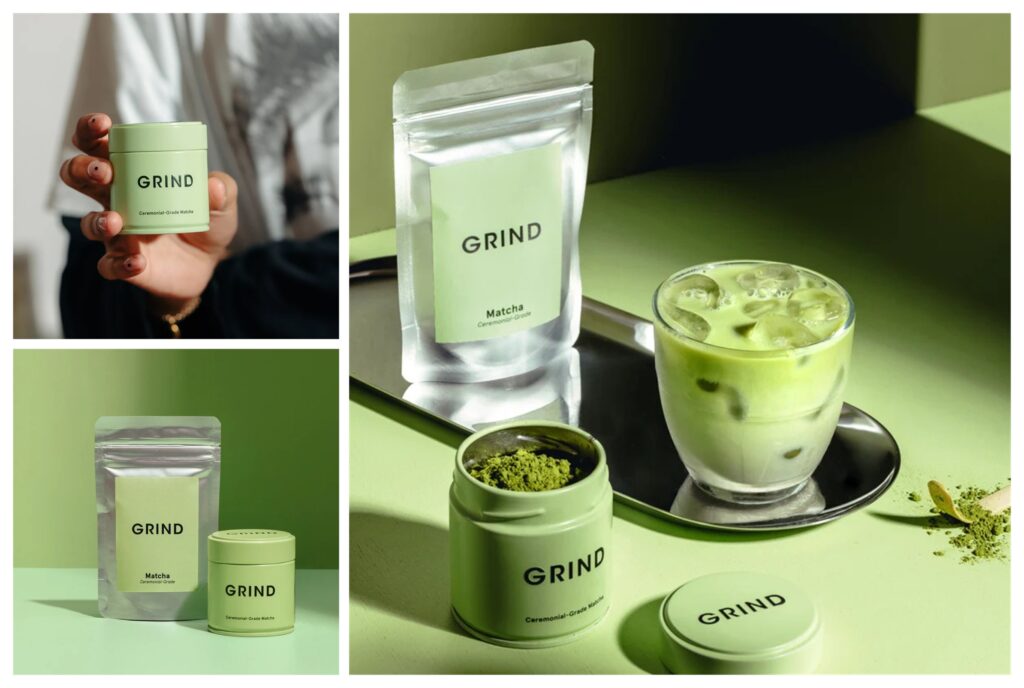
Partner with local cafes, wellness studios, or bakeries depending on your grade. Offer starter kits by bundling your metal tins with bamboo whisks (chasen) or baking tools to encourage interaction and add value.
Fazit
Starting a matcha brand requires careful planning at every step, but it is a highly rewarding journey. We hope this guide has given you a clear roadmap. If you are ready to find the perfect airtight packaging for your premium matcha, contact us today for custom solutions and low-MOQ options!
 German
 English
 Arabic
 Greek
 Italian
 Spanish
 Russian
 French
 Japanese
 Korean
 Thai
 Vietnamese